← 返回博客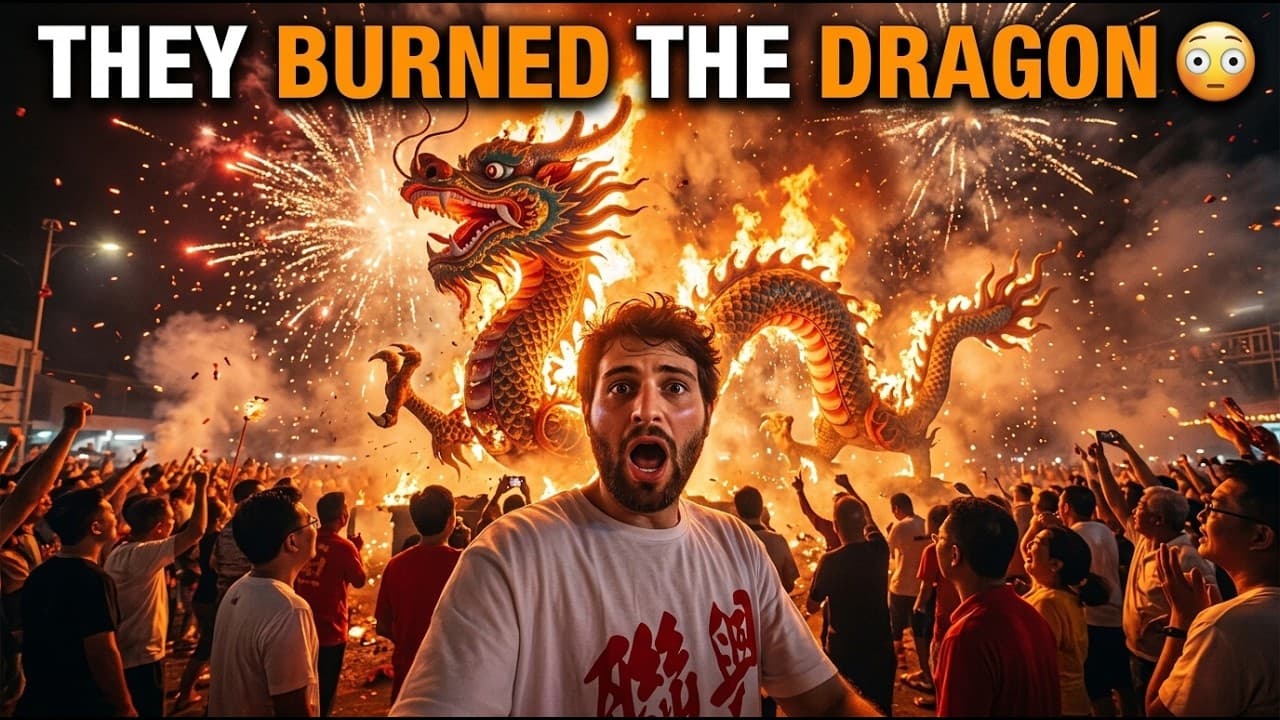
2026年9月1日
Mazu Festival in Kuching: A Dragon-Burning Ritual Guide
The Mazu Festival in Kuching, Malaysia gave me one of the wildest nights I've had anywhere in Borneo, and it ended with a giant paper dragon going up in flames in front of a crowd of thousands. I'd spent part of the day helping carry that same dragon through the streets, never expecting that a few hours later I'd be watching it burn while fireworks tore through the dark and the noise around me turned into something close to chaos.
Mazu is one of the most widely worshipped deities among Chinese communities with roots along the southern coast of China, particularly among Hokkien and Teochew seafaring families who carried her worship with them as they settled across Southeast Asia. She's venerated as a protector of fishermen and sailors, a goddess believed to calm storms and watch over anyone who makes their living on the water. Kuching, like many port cities across the region, has a Chinese community old enough and large enough that festivals like this one aren't a novelty staged for outsiders, they're a real, living part of the yearly calendar, the same way Qing Ming and the Hungry Ghost Festival are marked here without much fanfare for visitors.
Earlier in the day, I joined in and helped carry the dragon itself, a long, elaborate construction built to be paraded through the streets as part of the festival's procession. Dragon dances and processions like this are a fixture of Mazu celebrations across the Chinese diaspora, usually paired with firecrackers, drumming, and enough noise to announce the goddess's presence to the entire neighborhood. What I hadn't clocked yet, while I had my hands on the dragon's frame in the afternoon heat, was that the same dragon we were parading around so carefully was going to end the night in a fire.
That's exactly what happened once night fell. The dragon we'd carried earlier was set alight at the end of the celebration, and the calm, ceremonial atmosphere of the procession gave way almost instantly to something closer to controlled chaos. Fireworks and explosions went off all around us as the dragon burned, and within moments I was standing in the middle of a crowd of what felt like thousands of people, packed shoulder to shoulder, all watching the same fire and reacting to the same bursts of noise and light. It's the kind of scene that's hard to process while it's actually happening around you: the heat off the flames, the smell of smoke and gunpowder, and a wall of sound coming from every direction at once. Burning an effigy at the close of a festival like this is a practice you'll find in different forms across Chinese folk religion, often tied to the idea of sending something, an object, an offering, sometimes a spirit, off into another realm once its purpose in the physical world is done. Whether or not that was the exact intention behind this particular fire, it's the kind of ritual logic that runs underneath a lot of what looks, from the outside, like pure spectacle.
I've filmed a lot of festivals traveling through Malaysia and Borneo, and this is still the one I'd point to as the wildest single moment I've witnessed. It wasn't just the fire or the fireworks individually, it was the combination, the size of the crowd, the noise bouncing between buildings, and the fact that a few hours earlier I'd literally had my hands on the thing that was now burning in front of several thousand people. There's a particular kind of disorientation that comes from watching something you helped carry get destroyed on purpose, in public, as the entire point of the evening.
If a Mazu Festival dragon burning in Kuching is something you want to see for yourself, the practical starting point is timing: Mazu's festival dates follow the Chinese lunar calendar rather than a fixed Gregorian date, so it's worth checking local Chinese temple associations or community calendars in Kuching ahead of a trip rather than assuming a set month. Kuching itself, as the capital of Sarawak on the island of Borneo, is well connected by air to Kuala Lumpur and other regional hubs, which makes it a manageable base for catching festivals like this one if your timing lines up. Once you're there, the festival activity tends to center on the city's Chinese temples and the streets around them, where processions, dragon dances, and the closing rituals typically take place. Expect real crowds and real noise if you go, this isn't a quiet cultural performance staged behind glass, it's a packed, loud, occasionally overwhelming event that the local community is genuinely participating in rather than performing for cameras. Standing back a little during the actual burning is worth it too, both for safety around the fireworks and because it's still, fundamentally, someone else's religious celebration rather than a show.
What stays with me from that night isn't a single image so much as the whiplash of it, carrying a dragon peacefully through Kuching's streets in the afternoon, then watching it consumed by fire and fireworks a few hours later with thousands of strangers pressed in around me. If you're chasing genuinely unpredictable cultural experiences in Malaysian Borneo, a Mazu Festival dragon burning in Kuching is exactly the kind of night that earns the trip.
最初发布于 YouTube