← 返回博客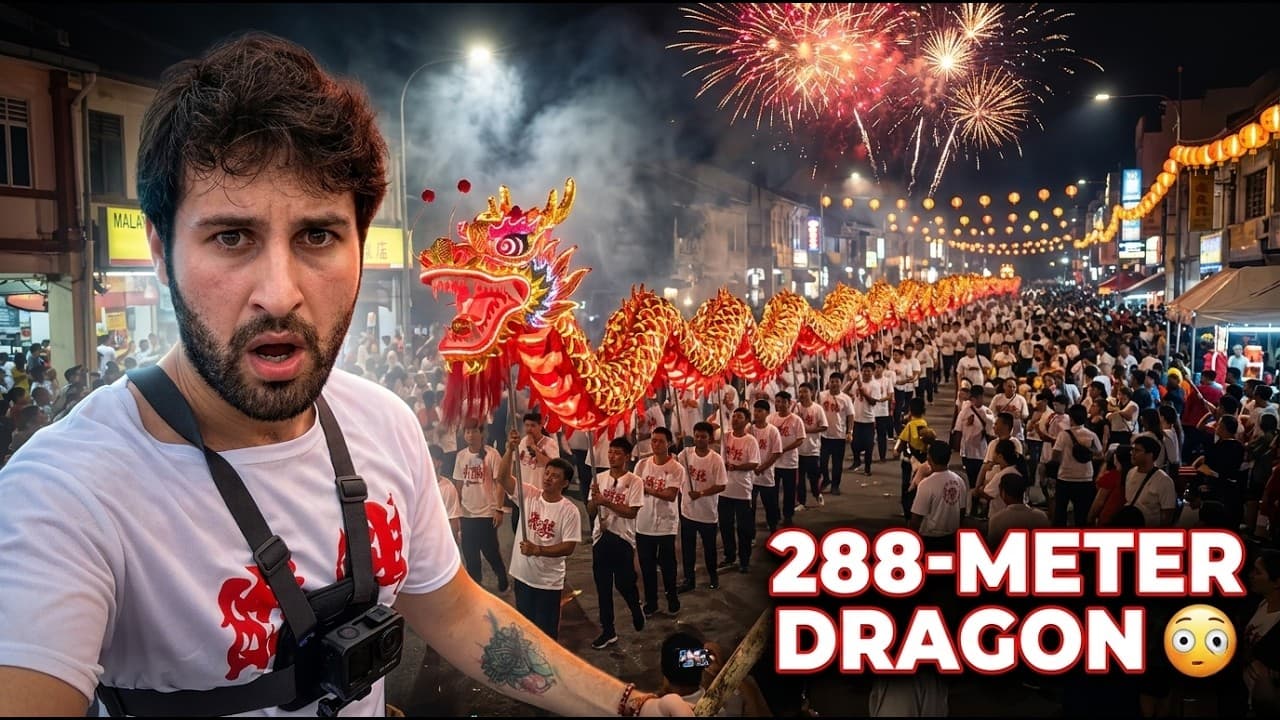
2026年9月8日
How to Join Kuching's Mazu Festival Dragon Parade
I didn't plan on joining the Kuching Mazu Festival dragon parade. It started, of all places, with a conversation with a homeless man in Kuching, the kind of chance encounter that tends to lead somewhere unexpected in this city. He pointed me toward a street a few blocks away and told me something big was happening there. I almost didn't bother going to check, but curiosity won out, and a short walk later I was pulling on a volunteer's festival shirt and getting ready to help carry a dragon that stretched 288 meters down the road.
The festival turned out to be one of the largest street celebrations I've come across anywhere in Malaysia. Thousands of people packed the route, spilling off the sidewalks and out of shopfronts, all waiting for the procession to pass. Once I had a festival shirt on and someone showed me where to stand along the dragon's frame, I stopped being a spectator and became part of the parade itself. Carrying even one section of a 288-meter dragon takes real coordination with dozens of strangers moving in the same rhythm, lifting and lowering the long body so it seems to ripple and swim through the crowd rather than just being dragged along. My arms were aching within minutes, but nobody around me seemed to be slowing down, so I kept pace. Drummers kept time beside us while performers spun and danced ahead of the dragon's head, working the whole street into a level of noise and color that felt closer to Rio's Carnival than anything I expected to find on the island of Borneo.
The celebration is tied to Mazu, the sea goddess widely worshipped across Chinese communities throughout Southeast Asia, especially among descendants of coastal Fujian and Hokkien migrants who settled in port cities like Kuching generations ago. Dragon dances and processions built around her worship are common in these communities, tracing back to older maritime traditions where sailors and fishing families sought her protection before heading out to sea. But the scale of Kuching's version, a dragon long enough to need dozens of carriers strung out over a full city block, is what makes it stand out even among other Mazu celebrations in the region.
If you want to catch the Kuching Mazu Festival dragon parade for yourself, the simplest approach is to be in Kuching's older, historically Chinese neighborhoods when the celebration is underway and just follow the noise. Drums and crowds tend to gather well before the dragon itself comes into view, so arriving early gives you a better vantage point along the route. Actually getting invited to carry the dragon, the way I was, isn't something you can really plan for. It comes down to being in the right place, talking to the right person, and being willing to say yes on the spot rather than staying on the sidelines. From what I experienced, organizers are welcoming toward visitors who show genuine interest, and volunteers are handed a shirt so they're identifiable as part of the procession rather than someone just weaving through it uninvited. Expect the route to move slowly, with frequent stops for performers to run through longer routines for the crowd, so treat it as an afternoon-or-evening event rather than a five-minute photo stop before moving on to something else.
What stayed with me afterward wasn't really the size of the dragon, impressive as it was, but how fast the day turned from a passing conversation with a stranger into becoming, briefly, part of one of Malaysia's biggest festivals. That's the kind of thing that seems to happen in Kuching if you stay open to it: a stranger's tip, a shirt handed to you, and suddenly you're carrying part of a 288-meter dragon through a crowd of thousands, no plan required and no idea, an hour earlier, that any of it was coming.
最初发布于 YouTube