← Back to blog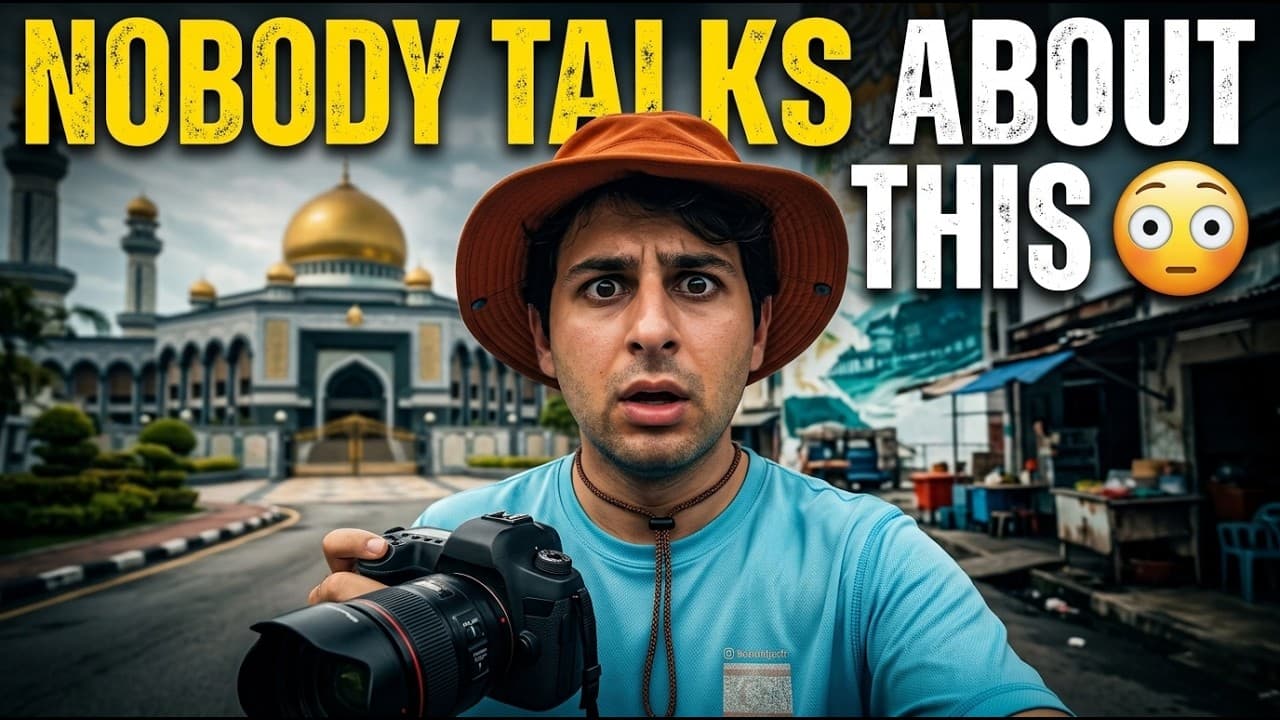
August 21, 2026
Brunei's Only Buddhist Temple: How to Visit
Brunei's only Buddhist temple sat at the end of a walk I almost didn't plan to take. This was the final day of a Brunei series that had already covered a host's home, hitchhiked rides, and a small Sultanate that most travelers only see from a layover window, and it closed with exactly the kind of afternoon that sums up why slow travel works: no fixed itinerary, just a walk out the door and into whatever the city center handed over.
The day started simply. After saying goodbye to the family who had hosted us for the last stretch of the Brunei leg, the plan was just to walk, with no destination fixed in advance. That meant time in the city center, talking with whoever was around, and noticing the kind of small, unscripted details that never make it into a five-minute highlight reel of a country most people associate with little more than its Sultan and its skyline. Brunei rewards that kind of aimless walking more than most places, since so much of what makes the country distinct sits just off to the side of the obvious sights rather than front and center.
One of those details turned into the real center of the day: Brunei's only Buddhist temple. In a country that is an absolute monarchy built around Islamic law, where the call to prayer and the Sultan's presence shape daily life more visibly than almost anywhere else in Southeast Asia, a single Buddhist temple is an unusual kind of landmark. It isn't the country's headline attraction, and it doesn't try to be. It exists because Brunei's small ethnic Chinese community has kept its own religious life going here for generations, alongside, not instead of, the country's official faith. Walking through it after days spent almost entirely inside a Muslim-majority framework was a reminder that even a small, tightly governed country holds more religious texture than its reputation suggests. It's also the kind of stop most Brunei itineraries skip entirely, partly because there's only one of it in the whole country, which makes it worth actively seeking out rather than hoping to stumble into.
The more memorable part of the day, though, wasn't the temple, it was who we met around it. Bangladeshi workers living and working in Brunei turned into some of the best conversation of the entire trip: stories about travel, about the specific kind of kindness that shows up when you're far from home doing a job most locals would rather not do, and about hospitality that ran in both directions even though neither side had much to spare. None of it was scripted or arranged in advance, just people willing to talk, and the conversation ran long enough that, by the end of the day, it had become one of the most memorable parts of the entire Brunei chapter of this trip. It's a reminder that migrant labor communities are often the ones most willing to sit down and actually talk to a stranger with a camera, since they know better than almost anyone what it feels like to be the outsider in a new country.
By the time the light started to shift, it was time to do what had defined most of this trip already: hitchhike. One last ride, arranged the same improvised way as every other leg of the Brunei series, closed out both the day and the country. There's a certain symmetry in hitchhiking both into and out of a place: arriving depends on strangers willing to stop, and leaving works exactly the same way.
For anyone actually planning to visit Brunei's only Buddhist temple rather than stumbling onto it the way this trip did, the shape of a day like this is easy to recreate even without a fixed itinerary. The temple sits within walking distance of Brunei's compact capital, close enough that a city center walk can plausibly end there without arranging a car in advance. Brunei generally rewards an unhurried pace: it's a small country, distances are short, and a day built around walking, talking to whoever's around, and seeing where the afternoon goes tends to turn up more than a checklist itinerary would. Anyone visiting should also keep in mind that Brunei is a conservative, alcohol-free Islamic sultanate, so modest dress and quiet, respectful behavior matter here more than in most Southeast Asian stops, including around a minority site like this temple.
What stuck by the end wasn't the ritual of ticking off a landmark, it was the accumulation of the whole series: a host's home, a city center walk, a temple that exists because a small community insisted on keeping it, a long conversation with Bangladeshi workers who had their own reasons for being so far from home, and one more hitchhiked ride out. Brunei doesn't get covered often in travel content, and the side of it that rarely makes it to a screen isn't the palace or the skyline, it's exactly this: quiet mornings, long conversations, and a Buddhist temple standing on its own in a country built around a very different faith.
Originally posted on YouTube