← Back to blog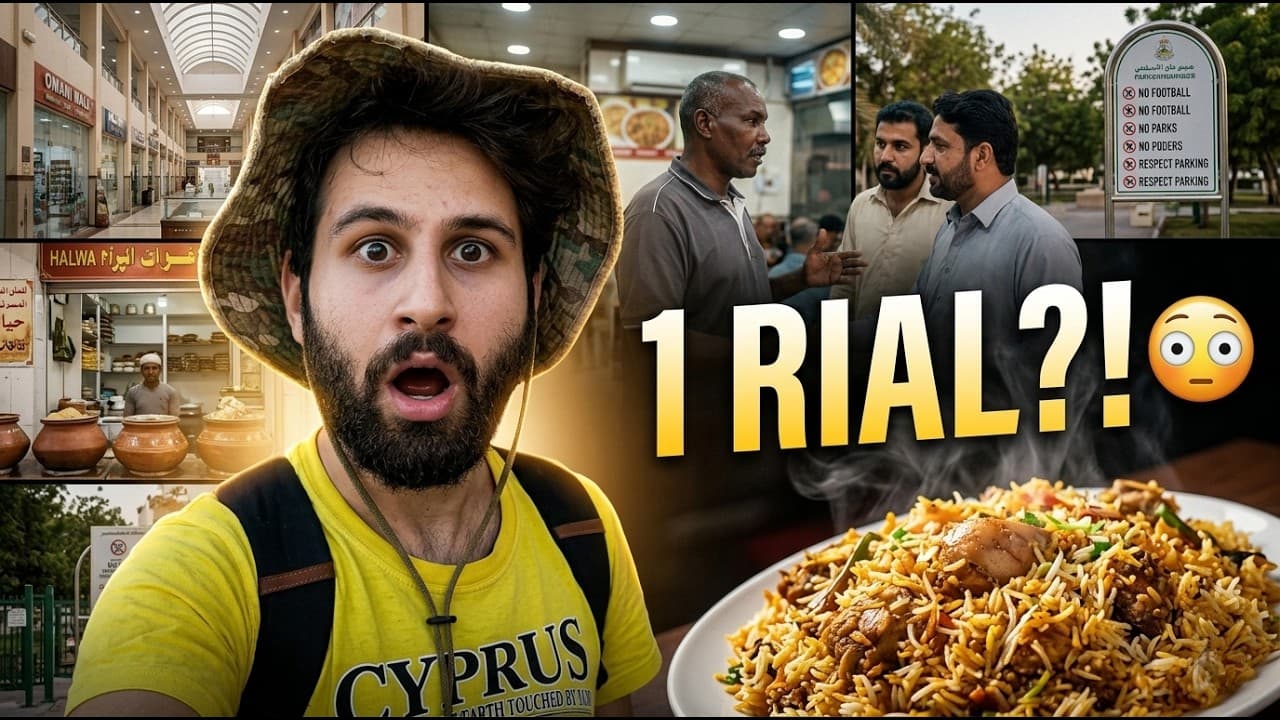
October 5, 2026
1 Rial Biryani in Muscat: Where to Eat Cheap in Oman
I didn't plan this day in Muscat around food at all, but it turned into exactly the kind of day that answers a question a lot of visitors end up asking once they get past the glossy malls along the coast road: where do you actually find cheap eats in Muscat, Oman, once the postcard version of the city stops being the point?
It started at one of those malls, the air-conditioned, marble-floored kind that could be in almost any Gulf city, and for a while the day looked like it was going to stay exactly that ordinary. Then the plan shifted toward something smaller and more specific: a Pakistani restaurant tucked away from the mall crowds, the kind of place with plastic chairs and a menu that doesn't bother translating itself for tourists. That's where the biryani showed up, a full plate of it for one Omani rial, and it's the kind of price that makes you stop and actually look around at who else is eating there. The answer, mostly, was working men on a lunch break rather than anyone passing through on a tour itinerary, and the biryani itself was proof that Muscat's cheap eats aren't hiding in some obscure corner, they're sitting in plain sight next to restaurants charging ten times as much.
From there the day kept its momentum toward small, unglamorous finds rather than big sights. A local halwa shop was next, one of the dense, sticky, saffron-colored confections that Oman is quietly serious about, sold out of shops that look more like a spice stall than a dessert counter. Halwa in Oman isn't really a novelty item for visitors, it's a staple that shows up at celebrations and everyday gatherings alike, and tasting it fresh from a neighborhood shop rather than a tourist-facing stand made it feel like a genuinely local stop rather than a box to check.
The part of the day that actually stuck with me longest wasn't the food, though. Walking back out into the street, I ended up in conversation with a Sudanese man who'd clearly built a life in Muscat, the kind of long, winding conversation that happens when neither person is in a hurry to be somewhere else. He had his own story to tell, the specifics of which are really his to tell and not mine to summarize secondhand, but at some point the conversation drifted toward Cyprus, and he started asking genuine, curious questions about what it's like to travel there. It was a small moment, but it said something real about Muscat that doesn't show up in a guidebook: this is a city built on a wide mix of people from across South Asia and East Africa who've put down roots here for work, and a random conversation on the street can turn into exactly this kind of exchange, two people comparing notes on places neither of them currently calls home.
Later, walking around with Artyom, the friend I was traveling with that day, we ended up in one of Muscat's public parks, and that's where the day's last surprise showed up: a handful of local rules posted around the space that neither of us had expected, the kind of small regulations that remind you you're operating under a different set of everyday norms than wherever you flew in from. Nothing dramatic, just enough of a nudge to notice that public space in Oman comes with its own quiet logic, one that's worth paying attention to rather than assuming it matches whatever you're used to at home.
If you're trying to actually find cheap eats in Muscat, Oman rather than just sticking to the malls and the postcard sights, the real approach is to walk past the first mall food court you see and look for the restaurants serving the city's South Asian workforce, that's consistently where the best value sits. A full biryani plate for close to a single rial isn't a fluke, it's the going rate at the kind of no-frills restaurant that doesn't bother with an English menu, and a halwa shop in almost any residential neighborhood will sell you dessert for a fraction of what a hotel café charges for the same thing. Give yourself an unstructured afternoon rather than a tight schedule, since the best parts of a day like this come from wandering rather than planning, and don't be surprised if a stranger on the street turns out to be more memorable than anything on the map.
What made this particular day in Muscat worth writing about wasn't any single stop, it was the accumulation of small, ordinary moments that a packed sightseeing itinerary tends to crowd out entirely: a cheap plate of food, a dessert shop, an unplanned conversation, a park with its own rules. None of it was dramatic, and that's sort of the point. If you want to actually understand how people live in Muscat rather than just see it, a day built around food this ordinary will get you closer than any landmark on the map.
Originally posted on YouTube